How Long Does Provider Credentialing Take?
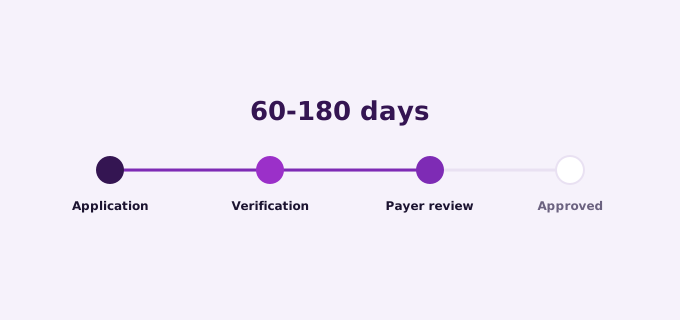
Provider credentialing takes 60–180 days on average, depending on payer and specialty. Practices lose $7,000–12,000 per provider per month during enrollment delays. The most effective way to reduce the timeline is parallel processing — starting all payer applications simultaneously rather than sequentially.
The short answer: 60–180 days, depending on the payer
Commercial payer credentialing typically completes in 60–90 days. Medicare PECOS enrollment typically runs 30–60 days (and has become more complex since the May 2026 migration to the new AWS-based PECOS 2.0 platform with mandatory MFA). State Medicaid credentialing varies significantly — some states process in 30 days; others routinely take 120+ days. The total timeline for a new provider to be credentialed with all their intended payers is typically 90–150 days when well-managed, and can stretch to 180 days or longer when applications have errors or are submitted sequentially.
What drives the timeline
The largest factors affecting credentialing timeline are application accuracy (errors trigger restart cycles that add 30–60 days), primary source verification speed (medical schools, licensing boards, and malpractice carriers have their own processing times), payer-specific committee meeting schedules (many commercial payers credential only at monthly committee meetings), and completeness of the provider's documentation package. Missing or outdated documents — an expired DEA certificate, an incorrect NPI, a gap in the employment history — are the single most common source of delays.
The revenue impact of delays
Practices lose $7,000–12,000 per provider per month during enrollment delays (industry estimates). A single provider representing 15–20 patients per day at typical reimbursement rates can represent $30,000–60,000 per month in revenue. If that provider can't bill for 90 days because credentialing wasn't started early enough, the practice has permanently lost that revenue — timely filing windows mean delayed services often can't be back-billed even after credentials are approved.
The most effective timeline accelerator: parallel processing
The biggest mistake practices make is submitting payer applications sequentially — waiting for CAQH to be complete before starting Medicare, waiting for Medicare before starting commercial payers. Running all applications in parallel, starting from the day the provider is hired, is the single most effective timeline accelerator. With parallel processing, most providers are credentialed with their primary payers within 60–90 days of hire. With sequential processing, the same process takes 150–180 days.
CAQH re-attestation: the ongoing credentialing task most practices miss
CAQH ProView requires re-attestation every 120 days. A lapsed CAQH attestation triggers claim holds across all commercial payers simultaneously — silently, often with no direct notification to the practice. By the time the holds show up as denials, 30–60 days of claims may already be affected. ImmediCare tracks every provider's CAQH attestation deadline and completes re-attestation before the window lapses.
Common questions about credentialing
Ready to fix your billing?
Get a free, no-obligation billing audit — we\'ll show you exactly where your practice is losing revenue.
Get a free billing audit