How to Reduce Medical Claim Denials (2026)
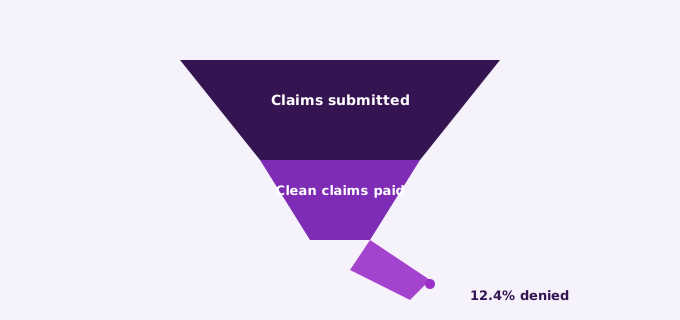
The national claim denial rate reached 12.4% in 2025 — the highest in a decade. Each denial costs $28–32 to rework. Up to 86% of denials are preventable. This guide explains the systematic steps to reduce denials before and after submission.
Why denials are getting worse
Claim denial rates have climbed every year since 2020, driven by three converging trends. First, payers have deployed AI denial engines that flag claims in milliseconds based on patterns in documentation and coding — with no grace period for human review. Second, the transition to ICD-10 and the 2021 AMA E&M guideline changes created new coding complexity that many practices haven't fully absorbed. Third, staff turnover in billing departments has reached crisis levels — 41% of billing roles are more than half-vacant (MGMA) — leaving claims to be processed by undertrained or overworked staff.
The two categories of denial prevention
Denial reduction happens at two points: before the claim is submitted, and after it's denied. Pre-submission prevention is far more cost-effective — catching a potential denial before submission costs nothing and avoids the $28–32 rework cost. Post-submission denial management is necessary for the denials that get through, but it's expensive and time-consuming. The highest-performing billing operations reduce denials upstream and have a systematic process for the ones that remain.
Pre-submission: the five critical checks
The most impactful pre-submission checks are: eligibility verification (confirm coverage before the visit, not after), coding accuracy (ICD-10 and CPT accuracy reviewed against clinical documentation), prior authorisation confirmation (verify auth is in place before the claim is built), claim scrubbing against payer-specific edits (every payer has different rules — scrub against all of them), and timely filing tracking (every payer has a filing deadline — missing it is unrecoverable revenue loss).
Post-submission: working denials systematically
Of the denials that get through, 54% can be successfully overturned on appeal (AHA) — but only if the appeal is filed promptly and with the right documentation. The keys are: categorise every denial by reason code and payer immediately, prioritise by dollar value and appeal deadline, file appeals with complete clinical documentation and a clear payer-specific argument, and track every appeal through to resolution. Most in-house billing teams don't have the bandwidth to work all denials systematically — they triage the large ones and let smaller denials age out. A specialist denial management team works every denial, regardless of size.
Root cause analysis: fixing denials at the source
The most powerful long-term denial reduction strategy is root cause analysis — looking at denial patterns across payers, reason codes, and providers to identify systematic problems. If 40% of your cardiology denials are for the same modifier error, fixing that upstream eliminates 40% of a denial category permanently. Most practices don't do this analysis because they don't have the time or the data visibility. A billing partner with proper reporting surfaces these patterns automatically.
Common questions about denials
Ready to fix your billing?
Get a free, no-obligation billing audit — we\'ll show you exactly where your practice is losing revenue.
Get a free billing audit