In-House vs Outsourced Medical Billing: The Straight Comparison
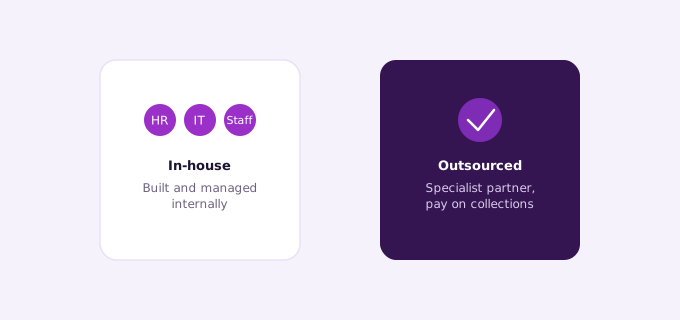
In-house billing gives you control but costs more and depends on individual staff. Outsourced billing costs less, produces higher clean claim rates, and eliminates staff dependency — but requires trusting a partner with your revenue. This guide walks through both models honestly.
Control vs cost: the core tradeoff
The in-house vs outsourced billing decision comes down to one fundamental tradeoff: control versus cost and performance. In-house billing keeps the function inside your practice, where you can supervise it directly. Outsourced billing trades that direct supervision for lower cost, higher specialisation, and better outcomes — if you choose the right partner.
When in-house billing makes sense
In-house billing works best when a practice has sufficient volume to justify dedicated billing staff (generally 5+ providers), when specialty-specific billing knowledge is rare enough that it's worth retaining internally, and when practice leadership has the bandwidth to manage billing staff performance. For large multi-specialty groups with well-managed billing departments, in-house can deliver competitive results. For most practices below that threshold, the economics don't support it.
When outsourced billing makes sense
Outsourced billing makes sense for solo and small practices (the vast majority of the market), practices where billing staff turnover is an ongoing problem, practices with rising denial rates or aging A/R, practices adding providers or new specialties where billing complexity is increasing, and any practice whose billing is currently managed by an office manager who "also does billing" as a secondary function. The 2025 MGMA survey found that 63% of practices report ongoing RCM staffing gaps — outsourcing eliminates that problem entirely.
The performance difference
Outsourced billing companies that specialise in medical billing achieve first-pass clean claim rates of 97–98%. The national average for in-house teams is lower, partly because staff turnover resets institutional knowledge and partly because a generalist in-house biller rarely matches the specialised expertise of a company where billing is the entire business. The 2025 national denial rate of 12.4% — a ten-year high — reflects exactly this expertise gap at scale.
What to look for in an outsourced billing partner
Not all billing companies are equal. The key questions are: Are coders AAPC or AHIMA certified? What is the clean claim rate? How are denials tracked and worked? Is pricing percentage-of-collections with no upfront fees? Is there a BAA and HIPAA-compliant data handling? Is there a dedicated account contact rather than a shared queue? And critically: are there lock-in contracts, or can you exit if performance is poor?
Common questions about choosing a model
Ready to fix your billing?
Get a free, no-obligation billing audit — we\'ll show you exactly where your practice is losing revenue.
Get a free billing audit