What is Revenue Cycle Management?
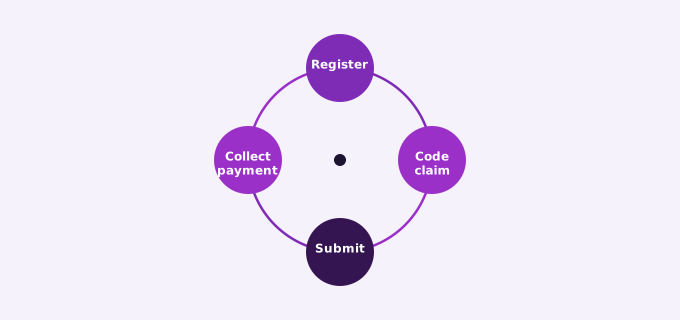
Revenue cycle management (RCM) is the financial process that covers every step from a patient scheduling an appointment to the final payment being collected by the practice. When RCM works well, it's invisible. When it breaks down, the results are predictable: rising denials, slow payments, and cash flow gaps.
The definition
Revenue cycle management (RCM) is the set of processes healthcare organisations use to track patient care episodes from registration and appointment scheduling to final payment. The term "revenue cycle" reflects the fact that this is a cycle — every patient encounter generates a financial transaction that must be managed from start to finish, and the outcome of that transaction directly determines the practice's cash flow.
The 12 steps of the revenue cycle
The full revenue cycle has twelve distinct steps. Pre-visit: patient scheduling and registration, insurance eligibility verification, prior authorisation when required. At the visit: charge capture, medical coding (ICD-10 and CPT), and charge entry. Post-visit: claim scrubbing and submission, payment posting, denial management and appeals, accounts receivable (A/R) follow-up, patient billing and collections, and reporting and analytics. Each step is a potential failure point where revenue can be lost — through errors, delays, denials, or missed charges.
Why RCM matters more than ever in 2026
The US medical billing outsourcing market reached $17.56 billion in 2025 — a reflection of how complex the revenue cycle has become. Payers now use AI denial engines that evaluate claims against thousands of rules in milliseconds. ICD-10 has over 70,000 diagnosis codes, each with specific documentation requirements. Credentialing must be maintained across dozens of payers simultaneously. Prior authorisation requirements have expanded across every specialty. For most practices, managing this complexity with internal staff has become either impossible or prohibitively expensive.
What good RCM looks like
A well-managed revenue cycle produces predictable, consistent cash flow. Claims go out clean and pay on first submission at a rate of 97–98%. Denials are caught early, worked systematically, and resolved before timely filing windows close. A/R stays below 30 days on average. The practice owner receives monthly reporting that clearly shows collections, denial rates, and payer performance — and can identify problems before they become crises.
In-house vs outsourced RCM
Practices can manage their revenue cycle internally or outsource it to an RCM company. MGMA data shows in-house billing costs an average of 13.7% of collections; outsourced billing typically costs 4–6%. The performance difference is also significant — outsourced billing companies that specialise in RCM achieve clean claim rates that in-house teams rarely sustain, particularly as payer complexity continues to increase. For most practices under 15 providers, outsourced RCM delivers better outcomes at lower cost.
Common questions about RCM
Ready to fix your billing?
Get a free, no-obligation billing audit — we\'ll show you exactly where your practice is losing revenue.
Get a free billing audit